Depth of Field and Aperture

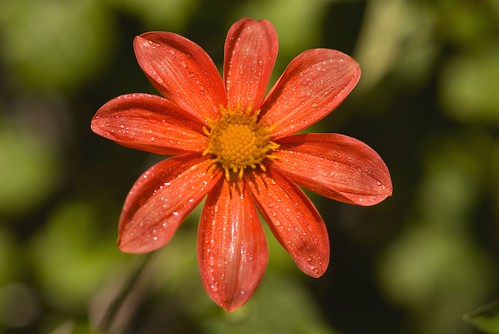
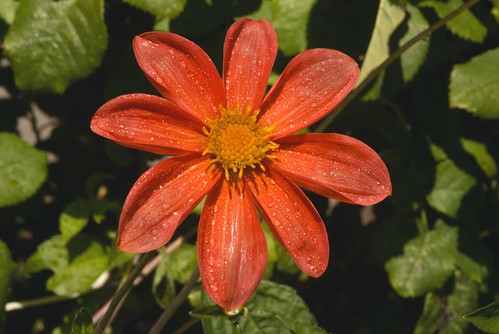
I shot these two photos of a dahlia to illustrate the impact of aperture on depth of field. The photo above, with a large aperture of f/4, has minimal depth of field, while the photo below with a small aperture of f/32 has much more depth of field.

The flower is in focus in both photos. In the low depth-of-field image (above) the background is out of focus, and therefore visually separated from the foreground.

In this situation, the low depth-of-field image is preferrable. An important point with low depth-of-field photos: since most of the photo will be out-of-focus, try to maximize the focus you do have by placing the camera as parallel as possible to the primary subject of the photo.

[Both photos: 105mm f/2.8 macro lens, 157.5mm in 35mm terms, ISO 100, tripod mounted. Above 1/1250 of a second at f/4, below 1/20 of a second at f/32.]
Dahlia at f/4

There’s lots of places to get great photography lessons online, so don’t get stuck just using the basic functions of your camera, learn more about it and get an online education you can be proud of. There are all kinds of grants for education so don’t let the cost deter you from learning all that you can!

Harold buys most of his digital photo equipment from B&H. Click here for Nikon DSLRs and here for Canon DSLRs. Keep in touch with what Harold is doing! For news, tips, techniques and special offers related to Harold's work and digital photography subscribe to the Harold Davis Photography email newsletter.

One Response to “Depth of Field and Aperture”

  1. Photoblog 2.0: » Photoblog 2.0 Archive: » Focus Says:

    […] Focus, in the sense of focusing the lens, is one of the primary variables in a photograph under the control of the photographer. Assuming, that is, that the photographer doesn’t rely on autofocus, and understands how focus relates to depth of field and aperture. […]

Leave a Reply

You must be logged in to post a comment.