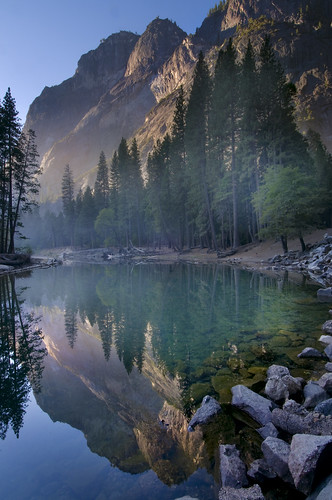
Yosemite Morning, photo by Harold Davis. View this image larger.

Coming down from a night spent photographing star trails on Glacier Point, I hit the Valley floor about 6AM. I tucked into my sleeping bag, inserted the ear plugs, and slept for a solid hour or so. At about 7AM a deep rumbling noise penetrated the ear plugs and woke me. It was followed by sirens (what’s this, bears dancing on cars setting off their alarms?) and then helicopters.
Sleep fled, and I pulled myself out to see what was going on. A big rock ledge had fallen off Glacier Point into the valley, and right into Curry Village. (Here’s the story. Very frightening if you were staying at Curry, but luckily no one was badly hurt, and the place has largely reopened.)
In the meantime, the Merced River beckoned in the morning light (you can see some of dust from the rock slide in the background of this photo).
To create this image I groggily shot six exposures, at times between 1/13 of a second and a full second. My initial plan was to process these together as an HDR image, using the Photoshop HDR automation. So I converted all six from the RAW using one ACR settings file, and then opening the six files using Merge to HDR. The results looked like garbage, Photoshop didn’t really know which areas to include from which exposure. Next, I tried merging to HDR using the pre-converted RAW files, with more-or-less the same ugly results.
So, it was back to hand combining the six captures using ACR setting variations, layer masking, gradients, and the Paintbrush tool. Computers are great, but sometimes automation sucks, and there’s nothing like doing it by hand.
Related story: Multi-RAW Processing versus Automated HDR.
[Nikon D300, 12-24mm Zoom lens at 12mm (18mm in 35mm terms), 1/13 of a second, 1/10 of a second 1/4 of a second, 1/2 of a second, and one second, all exposures at ISO 100 and f/22, exposures hand combined in Photoshop, tripod mounted.]
Pingback: Photoblog 2.0: » Photoblog 2.0 Archive: » Glory
Pingback: Photoblog 2.0: » Photoblog 2.0 Archive: » Stacking Star Trails: Tips & Techniques
Pingback: Tone Poem | Photoblog 2.0
Pingback: Stacking Star Trails | Photoblog 2.0
Pingback: Reflections from Stoneman Bridge | Photoblog 2.0