Archive for the ‘Flowers’ Category

Curves

Sunday, November 23rd, 2008

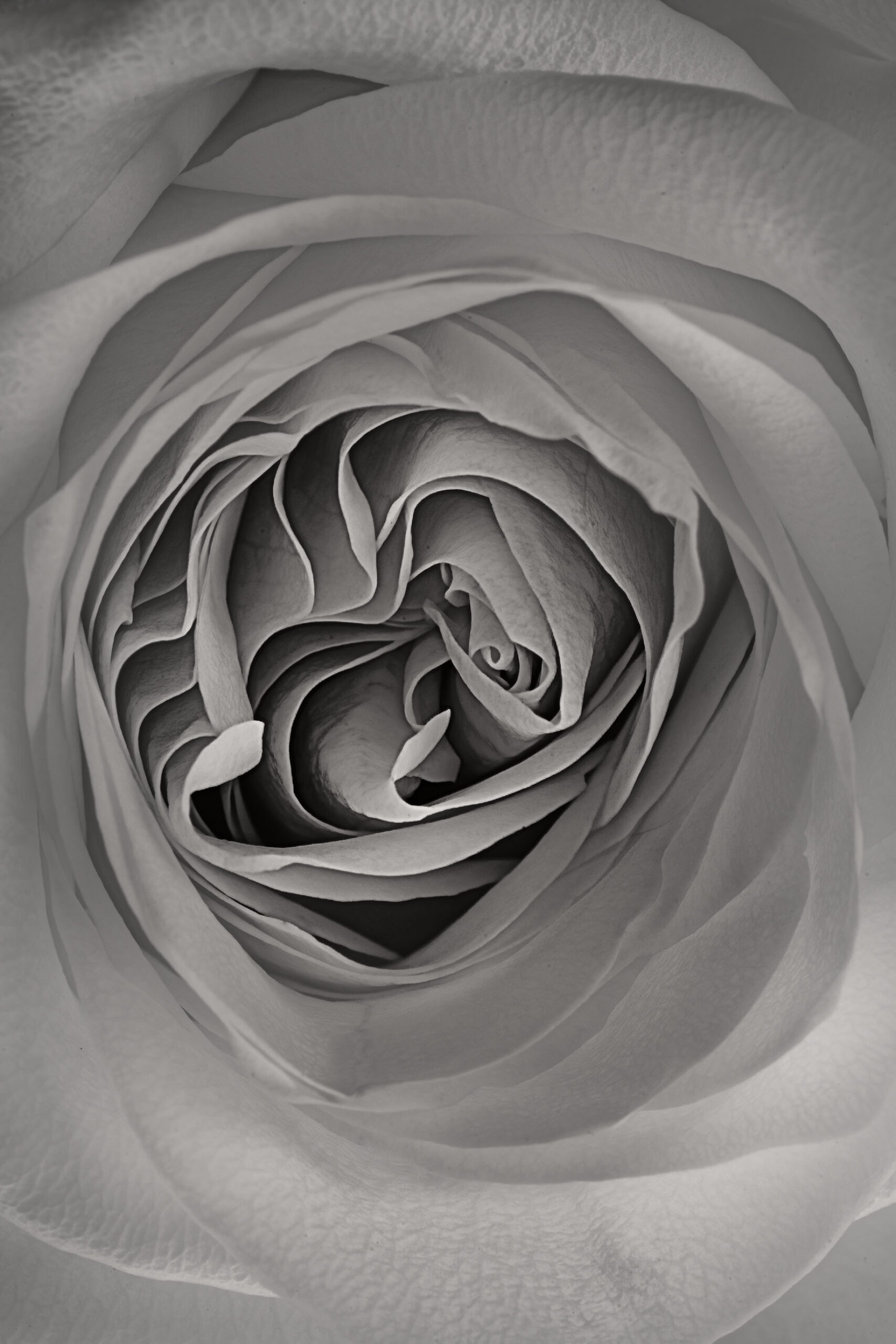
Dreamweaver Rose

Dreamweaver Rose, photo by Harold Davis. View this image larger.

I was doing some yard work in our garden. It’s great to have rose blossoms in late November, and the complex curvilinear shapes of this Dreamweaver called out to me. I snipped the flower, brought it inside, and photographed it straight down. I used a daylight balanced light box for the backlighting, and combined four exposures to extend the dynamic range of the composition.

[Nikon D300, 100mm f/2 Karl Zeiss macro lens, four exposures at 1 second, 2 seconds, 4 seconds, and 8 seconds combined in Photoshop, all exposures at f/22 and ISO 100, tripod mounted.]

Related images: Dreamweaver Rose, my Flowers on White set on Flickr.

Rose Heart

Thursday, November 13th, 2008

Time in this society, and on the Internet, is biased to the now. But who is to say that a photo I took a while back isn’t every bit as good as what I did yesterday? So, from time to time I repost from my archives. This is a reposting of images and a story originally published in June 2006.


Rose Heart, photo by Harold Davis. View this photograph larger.

Here are two roses with water drops from my garden for your viewing pleasure. The rose on top is a Dreamweaver from Jackson & Perkins. The one below is an Angel Face—always especially romantic to me because it was the flower that Phyllis and I featured at our wedding.

Wet Angel Face

View this photograph larger.

Rosa ‘Rio Samba’

Monday, November 10th, 2008

Rosa 'Rio Samba'

Rosa ‘Rio Samba’, photo by Harold Davis. View this image larger.

It rained over night. In the first light of the morning sun, I photographed the translucent petals of this Rose (Rosa ‘Rio Samba’), lush and drooping from the weight of the water.

[Nikon D300, 200mm f/4 macro lens, 1/80 of a second at f/40 and ISO 200, tripod mounted.]

Purple Flower Dance

Tuesday, November 4th, 2008

Purple Flower Dance

Purple Flower Dance, photo by Harold Davis. View this image larger.

Briefly noted: Like Gaillardia Gone to Seed, this is a flatbed scan, using a black velvet cloth taped into position as the background. For this kind of image, the resolution I can obtain from a decent flatbed scanner is fantastic compared to the best my camera can do—but, of course, there is very little depth and no control of depth-of-field.

Red and Purple Gladiola

Friday, October 31st, 2008

Red and Purple Gladiola

Red and Purple Gladiola, photo by Harold Davis. View this image larger.

Briefly noted: I carefully positioned the gladiola stems on a light box. I photographed almost straight down, but at a slight angle, using a telephoto macro. I made a wide range of exposures so I could be sure of capturing both the transparent effect and the entire possible dynamic range of the subject.

In Photoshop, I placed the different exposures in a layer stack, and used masking to control the color saturation. Then I inverted the white background and used my patent pending cross-channel blending system to bring out the colors (only kidding about the patent!).

[Nikon D300, Zeiss 100mm f/2.8 macro lens, five exposures between one and ten seconds combined in Photoshop, each exposure at f/22 and ISO 100, tripod mounted.]

Same Fuschia This Year

Wednesday, October 22nd, 2008

Fuschia Gradient

Fuschia Gradient, photo by Harold Davis. View this image larger.

Down the block, in front of Heidi’s house, there’s a great fuschia that grows buds like this one (Jet Engine and Doodling show buds from the same plant last year). Fortunately, Heidi has given me permission to snip buds whenever I like, so I can have an affair with the flowers every year.

This bud was photographed on a light box using a macro lens and extension tube. In Photoshop, I converted the image to LAB color. Next, I inverted the image (to get the black background) and combined the inversion with the original using a layer mask and a gradient blend.

[Nikon D300, 100mm f/2.8 Zeiss macro lens, 36mm Kenko extension tube, 3 combined exposures from 1/2 a second to 2 seconds, all exposures at f/22 and ISO 100, tripod mounted (using a Kirk Mighty Low Boy).]

Angel Wings in the Morning Dew

Wednesday, October 1st, 2008

Angel Wings in the Morning Dew

Angel Wings in the Morning Dew, photo by Harold Davis. View this image larger.

Briefly noted: A detail of the petal of a Dawn Chorus poppy in the early morning, shot this spring and never post-processed or posted due to the flurry of events around the birth of Katie Rose.

[Nikon D300, 200mm f/4 macro lens, 4 seconds at f/40 and ISO 100, tripod mounted.]

Simple Anemone

Friday, September 26th, 2008

Simple Anemone

Simple Anemone, photo by Harold Davis. View this image larger.

Briefly noted: this flower is a simple and small anemone from our garden, photographed using a daylight-balanced white box.

More anemone images: Anemone Japonica, White Anemone.

[Nikon D300, Zeiss Macro 100mm f/2 ZF Makro-Planar T* Manual Focus Lens, three exposures combined in Photoshop from 0.5 of a second to 2.5 seconds at f/22 and ISO 100, tripod mounted.]

Gaillardia Gone to Seed

Wednesday, September 24th, 2008

Gaillardia Gone to Seed

Gaillardia Gone to Seed, photo by Harold Davis. View this image larger.

This is a flatbed scan of the seed pods of Gaillardia. (You can see one of these pods in the foreground of this photo.) I used an Epson 9660 scanner set to the highest possible resolution that the scanner would actually do the scan, and imported the results directly into Photoshop.

I left the scanner lid open. The background is black velvet cloth jury-rigged over the three-dimensional pods with tape and sticks.

Some other flatbed scans: Iris Scans; My Brilliant Butterfly; Nautilus on Black.

Gaillardia Caucus

Saturday, September 20th, 2008

Gaillardia Caucus

Gaillardia Caucus, photo by Harold Davis. View this image larger.

Yesterday was the first rain of the season, a light mist that made the garden wet and saturated colors under a bright, but cloudy, sky. When I went out to photograph I was struck how my clump of Gaillardia in the side yard had proliferated. It’s hard not to love Gaillardia, and worth bearing mind that it is a native. Here’s a solo Gaillardia x grandiflora.

[Nikon D300, 200mm f/4 macro, 5 seconds at f/36 and ISO 100, tripod mounted.]

Cala Lily Flute

Friday, September 12th, 2008

Cala Lily Flute

Cala Lily Flute, photo by Harold Davis. View this image larger.

Briefly noted: I’ve been experimenting with monochrome (black and white) images of flowers and shells. These images start in my camera as RGB RAW color files. Of course, I never convert to black and white in camera because this would lose valuable information. However, I do use the black and white conversion feature in my camera to help me pre-visualize the way the photo will look. It’s not always easy to focus on blacks, whites, and contrast in a color world, and using the black and white conversion feature in my camera, but canceling at the last minute, helps me do this.

Once I’ve imported the photo into Adobe Camera RAW and Photoshop, I use the color information to get the photo to where I’d like it before applying black and white Adjustment layers. Usually, I employ multiple adjustment layers so I can control how specific areas of the photo are converted.

Nautilus in Black and White is one of my favorites so far.

[Nikon D300, Zeiss 100mm f/2.8 macro lens (read more about this lens), five exposures from 1/320 of a second to 1/13 of a second all at f/22 and ISO 500, tripod mounted.]

Fresco Flower

Monday, August 18th, 2008

[Note: this is a reposting of a story originally published in August 2005.]

I thought this photo looked like a painting when I took it, and I did my best to accentuate the effect in post-production processing.

First I applied Photoshop’s Fresco filter, then the Film Grain filter. After I cleaned the image up, I cloned some of the detail in the heart of the flower back in from the orignal image (proving, which I didn’t know before I tried, that you can use the Clone Tool between images, not just intra-image).

Check out some more of my recent flower pix (all post-processed in Photoshop, different manipulations and level of work involved):

Red Flowr

Dancing yellow flower

Bee

Rio Samba Rose Bud

Star of a Hollyhock

Sexy Angel Face

Thursday, August 14th, 2008

This is an Angel Face rose from my garden. I think it is so sexy!

Here’s another photo of the same rose bud, sexy (but in a different way):

Angel Face

[Note: this is a reposting of a story originally published in June 2005.]

Fourth of July Rose

Saturday, August 9th, 2008

Fourth of July Rose

Fourth of July Rose, photo by Harold Davis. View this image larger.

Briefly noted: For a special project I needed macro photos of flowers showing selective focus. I photographed this Fourth of July rose in high contrast late afternoon sunlight, with low depth-of-field and the focus on the core of the flower.

I intentionally underexposed by one EV (exposure value) so that I could get the almost ominous effect in the background, slightly out-of-focus petals. To draw attention to the center of the flower, I lightened this part of the photo with several lighter conversions brought in from camera RAW and layered in Photoshop. In post processing, I also selectively sharpened the center of the image (without sharpening the out-of-focus flower petals, which would have led to unfortunmate results).

Related stories: Gaillardia Lit from Behind, Fourth of July Rose.

[Nikon D300, Zeiss Macro 100mm f/2 ZF Makro-Planar T* Manual Focus Lens (150mm in 35mm terms), 1/640 of a second at f/4 and ISO 200, hand held.]

Spiral into Sunflower

Monday, July 28th, 2008

Spiral into Sunflower

Spiral into Sunflower, photo by Harold Davis. View this image larger.

Briefly noted: There are spirals in nature and grand artist-created spirals like Robert Smithson’s massive spiral jetty. There are also tiny spirals, like this spiral into sunflower made up of florets at the core of the flower.

The pixel is not concerned with its origin. A pixel knows neither what it portrays nor how it was made.

Some other spirals on my blog: Labyrinth, Resistance to Spirals Is Futile, Spiral in a Mallow, After the Wedding, Nautilus in Black and White, Nautilus on Black, Nautilus 69.